
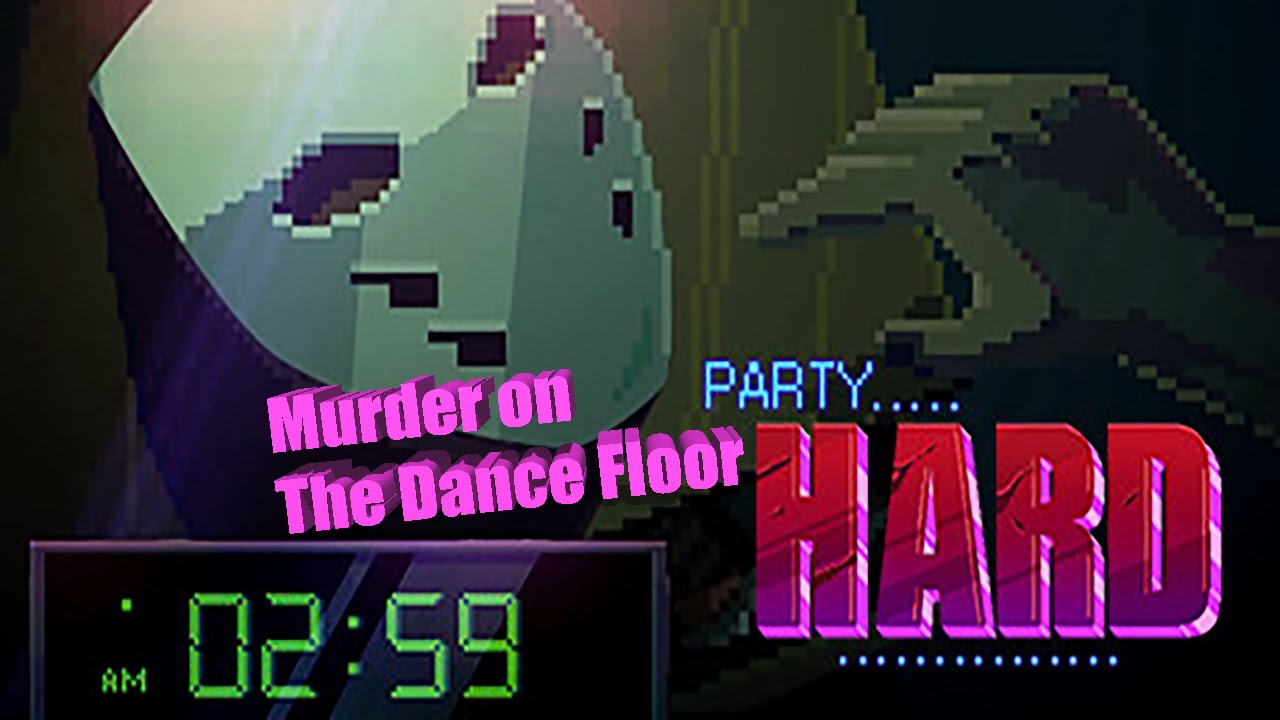
Do your neighbors annoy you? Do you like killing? If you answered yes to either of these, you might like Party Hard. I’ll set the stage for you. You’re a masked serial killer just trying to get some sleep. It’s 3 a.m. and your neighbors are really, really loud. So you kill them, all of them, while they party.
That’s basically the whole game. But it’s all wrapped up in a really great package of pixelated carnage, with more depth and strategy than you might expect. The game doesn’t have so much of a story as it does a singular purpose. Stop the noise. But this isn’t some mindless romp where you just run in and kill everyone. This is a game of careful planning and perfect execution. Sort of like chess, but with a knife.
The reason the game is so fun is because it asks you to think like a killer, and the closest comparison I can think of is Madness Interactive (the vaunted Flash game of the 2000s), mixed with the stealth of Hitman. Don’t get too excited just yet, though, as the game is far from perfect.
That single purpose — silencing the party — is what turns every gathering into a puzzle, and that is where the gameplay takes over.
Gameplay
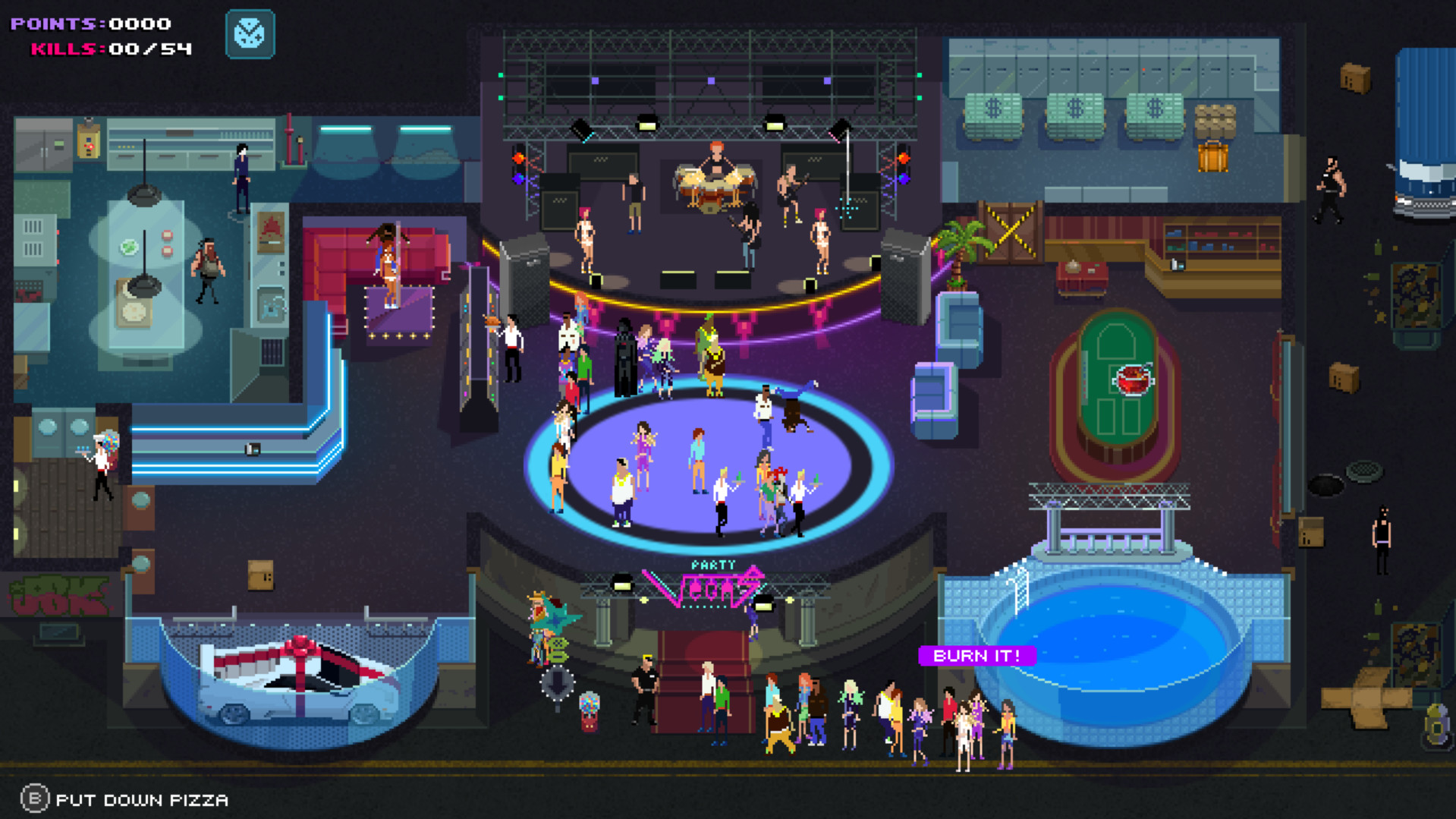
Each level starts off with you outside a house full of excited partying people. These people are all drinking, getting lewd, and smoking drugs — whatever you do at parties. And you are outside looking in, planning your next move. In many of these levels, you will also find people who are already dead — like a random guy hanging from the ceiling with a noose around his neck. If you have no idea what to do, this game tells you what to do in the first level: kill them all. So, you see, there is not much of a choice in the matter. But the choice comes in how you kill them, and how you avoid getting caught doing it.
You don’t have a gun, so instead of brute force you use smarts, well-laid traps, and whatever is close at hand. Because of this, traps become your best friends, and the knife is only the most basic option. A knife can kill one person at a time, and it leaves you standing right next to the body, where someone can see you. A trap, by contrast, can take out a group at once, often while you are somewhere else entirely. That difference matters on a crowded dance floor, where one careless kill can bring the whole party down on you.
So how do you kill them then? Well, there are a lot of options. You can set up traps, you can stab people, and you can also lead people to poison themselves. In fact, there are dozens of ways to kill people. As the levels progress, you will find that there are more people to kill and fewer traps to use. So, it gets harder — you have to be smarter about which trap you use, where you place it, and who you lure into it.
The trap toolkit itself rewards that kind of thinking. You can blow up a stove, poison a keg, use a stun bomb, or set a room on fire. Each one turns an ordinary party fixture into a weapon, and each one can catch several people who would otherwise have to be dealt with one by one. A poisoned keg, for example, does the work while the partygoers help themselves, and a well-placed explosion or fire can clear a room that a knife never could. The traps are the reason the game feels like a puzzle rather than a brawl: you are not just choosing a weapon, you are choosing a moment, a place, and a crowd.
Each level also has random events that trigger when you are on the level. So you might get a dark-coated stranger who will give you an item, or you might find a drug deal going down in the back room. The drug deal could be a way to get chemicals or weapons. Or, if you are feeling devious, you could expose the deal so that the police will come and shoot everyone. That randomness changes every level, because the plan that worked last time may not work this time: the stranger may offer something different, the deal may be somewhere else, and the police may arrive at a different moment. You have to adapt to what the level gives you, rather than simply repeating a route you already know.
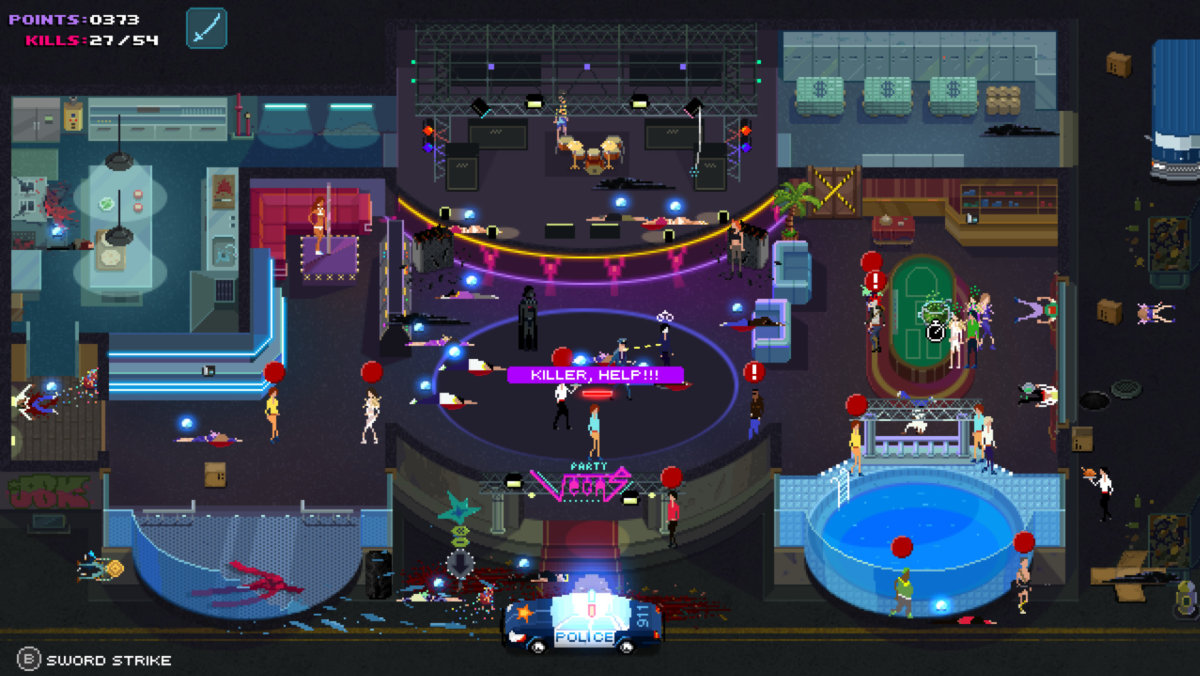
The police are as much of a problem as a help in this game, when you start killing people. So once you are found out, you had better run. The police also show up once they have been called. They can be a huge help because they shoot people indiscriminately, and they are just as likely to shoot the partygoers as they are to shoot you. But they are also a hazard for exactly the same reason: they will catch you if they can, and a party that looked finished can turn into a chase the moment they arrive. Used carefully, they are a weapon; used carelessly, they are the end of the run.
The game features a great soundtrack of intense EDM music. Exactly what you would expect at a party. It is loud, it is driving, and it keeps the pressure on while you wait for your moment. But do not let the music fool you into rushing: running in and stabbing everyone will get you killed. Careful planning and attention to traps are important here, because one noisy mistake can undo several minutes of quiet setup.
The game is played from the top down, similar to that other slaughter fest that is Hotline Miami. If you were expecting the same fast-paced action, though, you will be disappointed. This game is slow, methodical, and deliberate. You are not racing through a level; you are watching it, learning its rhythms, and waiting for the opening that lets you act without being seen.
The difference is clearest in the pacing. Hotline Miami is all about speed, where Party Hard is about chess. In Hotline Miami, you move fast and react faster. In Party Hard, you plan where and when to kill, and you accept that most of the game is spent setting the board rather than making the move. There are still hectic moments, but they are rare — usually after a misplaced kill, when you end up running after someone who is trying to stop them from setting off the alarm. In other words, you end up chasing someone who is trying to raise the alarm, and the calm plan suddenly becomes a frantic sprint.
Hitman penalizes you for killing, this game rewards you. In each party there will be a large number of people you need to kill, and as long as they end up dead, it doesn’t matter how you do it. You can set rooms on fire, blow them up, and poison them. Mostly, stabbing is the easiest — but there are also lots of poisons and one or two explosive traps, since they tend to get a larger number of people at once. The game does not judge your method, only your result, and that freedom is what makes experimenting with traps so satisfying.
All that planning is interrupted, in a good way, by the short scenes between parties, which give the game its story — such as it is.
Is there any story?
The game’s story plays out in between each party, where a hard-boiled detective will try to track you down. Each of these little vignettes is a refreshing breather from the intensity of the party with its nonstop EDM music. They slow the game down, let the tension ease, and remind you that your killer is not operating in a vacuum — someone is noticing the trail of dead parties behind him. Both the cut scenes and the game are in a pixel style. I like the pixel style because it plays down the gore a bit. Partiers can still explode into pools of red blood and bits of things, but since they are pixelated it is less offensive. The pixel art, in other words, softens what would otherwise be a much grimmer picture, and that softening is part of why the game’s violence can feel darkly comic rather than merely grim.
Those breathers are welcome, because the parties themselves are punishing.
This is a punishingly difficult game, several times I ended up getting caught and losing the level. This results in a total start over, no checkpoints. On a level where you might have to kill 40 or 50 people it can take 20 minutes to carefully set everything up. That is a long time to invest in a single attempt, and it means that one late mistake — one witness, one phone call, one policeman in the wrong place — can cost you the whole carefully built plan.
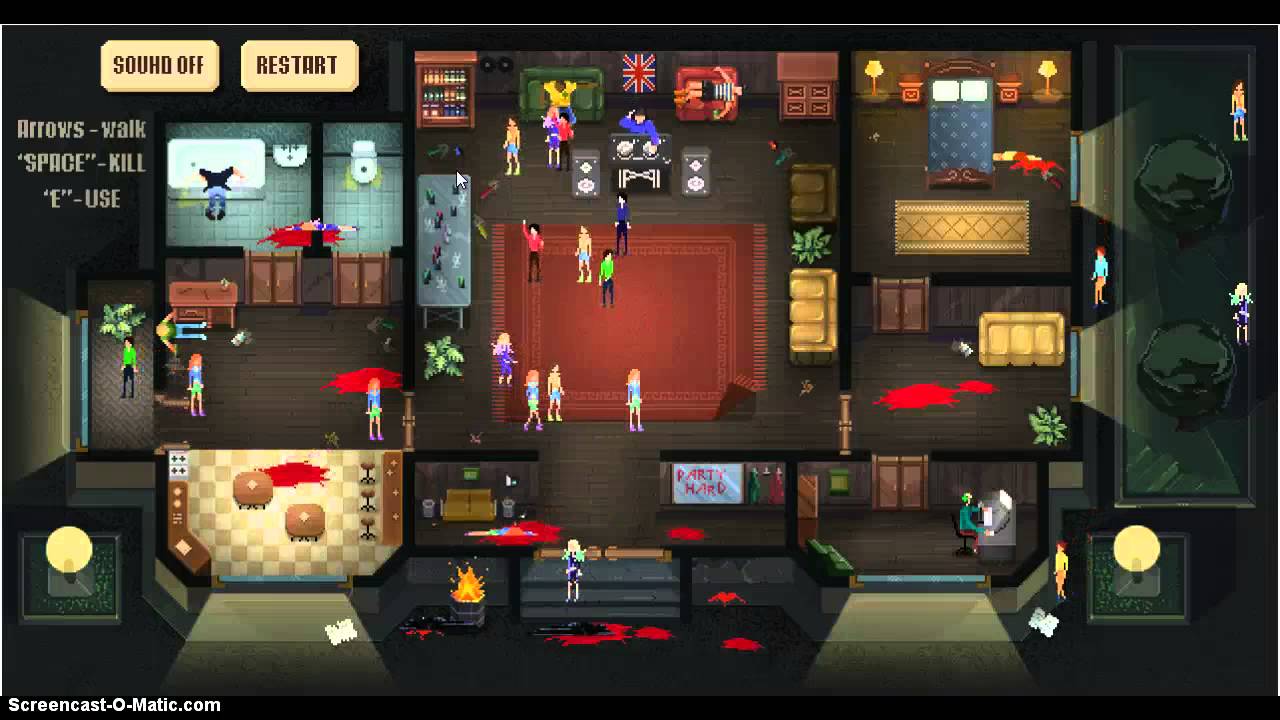
Each level is well designed, with a lot of rooms with doors that close, exit points, and traps for the partygoers. The rooms give you places to hide, to separate a victim from the crowd, and to funnel people toward a trap, while the closing doors and exit points give you ways in, ways out, and ways to be cornered if you are not careful. The design, in short, supports the slow, methodical play: every room is a small puzzle of doors, exits, and traps, waiting for you to read it correctly.
Sadly this is where we start to end up with a problem. Levels are different in layout, but all of the goals are the same. The game has one goal, and you are the lone agent of that goal. So even when the rooms change, the job does not: kill everyone, avoid being caught, and move on to the next party. The variety is in the setting, not in the objective, and over a long session that sameness starts to show.
That sameness is exactly what the verdict has to weigh against everything the game does well.
The verdict
I do have to say at least one bad thing about every game, so for this one I am picking its length and lack of diversity. Though the levels change, most players will quickly fatigue with having to kill two or three dozen people without being caught. Killing so many works well in games like Hotline Miami because of the frantic pacing, but this game features a much slower, methodical approach. Much time is spent simply waiting. Waiting for one person to walk away from the group to kill them. Waiting for a planted bomb to be in just the right place to go off. Waiting for the police to arrive, search, and then leave. It is for sure a waiting game.
That waiting, though, is also what makes the game’s surprises land so hard — and that brings us to its unplanned moments.
There are also some great moments as well. When you plant the bomb in the right place, and it kills half a dozen partiers, when a cop car screams up and kills 4 or 5 with no care at all. Some moments feel fun and unplanned. One level featured a meth lab in the back, and totally without my prompting a fight broke out there. This fight caused a fire, which killed many people. Through it all the DJ partied on. Those are the moments that stick with you, precisely because you did not script them: the game, the party, and a little bad luck collide, and half the room is gone before you have lifted a finger.
There is even some room for humor, subtle jokes abound. My favorite is the ability to make the protagonist dance to the frantic techno that is going on all around him as he kills his way through the game. I found myself often just sort of standing and listening to music. The joke lands because it is so out of place — a killer pausing mid-rampage to dance, as if the party were still just a party — and it captures the game’s strange, comic tone better than any single kill does.
Sadly the game has a few bugs that make it more difficult to play. Invisible phones have got to be the worst of all of these, as party patrons use phones to summon police. So, if you don’t know when they are coming, you will lose every time. That is not a fair challenge; it is a blind one, because you cannot plan around a warning you cannot see. Overall for the price point I think this game is well done and would recommend it.
Other than the eternally slow pace, I have very little bad to say about this game. Glitches can (and presumably will) be patched later on. Many people will no doubt take the timing of my review to be poor in light of recent events. However, I do not believe that this is a game of the type that promotes violence. Its cartoony aesthetic and lack of any realistic violence make it much less a murder simulator and much more just a fun game.
So the picture, taken as a whole, is a game whose greatest strength is also its greatest weakness. The slow, methodical trap-planning is the appeal: the careful watching, the poisoned keg, the stove, the stun bomb, the room set on fire, and the quiet satisfaction of a plan that clears a crowd without ever being seen. Against that, though, stand the waiting game and the repetition — waiting for someone to walk away from the group, waiting for a bomb to be in position, waiting for the police to search and leave, and then doing the same job again in a new layout with the same single goal. Add in the bugs, above all the invisible phones that can summon the police without warning, and you have a game that can frustrate as often as it delights. Even so, those frustrations do not outweigh the pleasure of a well-laid trap, a perfectly timed explosion, or a party that unravels all on its own. Overall I give this game a buy it rating, it is out now on iOS, Android, PC, PS4 and Xbox One.
Broken Joysticks was provided a copy of the PC version for review.