
Is Mountain a form of modernism or a screensaver? On one hand, Mountain offers a serene landscape and a breathtaking view of a mountain. On the other hand, it ages and becomes its own identity. Mountain lets you look at all sides and the more you look, the more it grows. What sets this mountain apart from other games? A game that offers no control of the outcome, but draws you in. That pull is part of the puzzle: the view itself is calm and beautiful, yet the mountain is not simply sitting still for you to admire. It changes as it ages, taking on a character of its own, and the longer you look at it from every side, the more there seems to be to notice. It asks for nothing from you, and still manages to hold your attention.
That tension between a peaceful view and a living, changing mountain is what makes David O’Reilly’s approach worth a closer look.
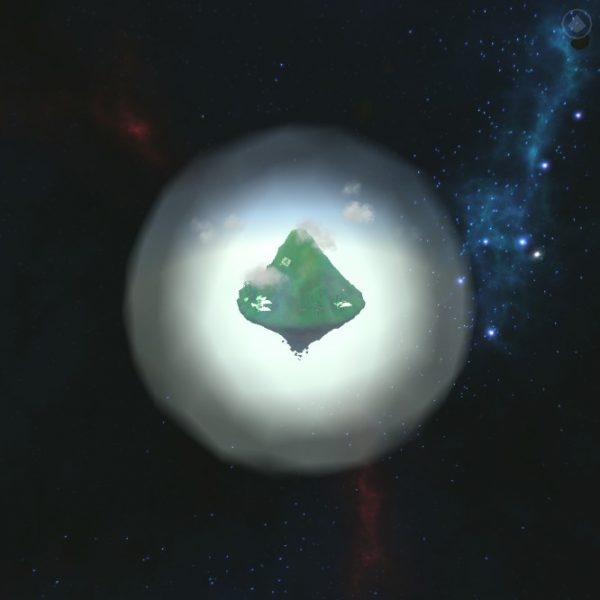
Mountain was created by David O’Reilly and is a relaxing simulator where its art is defined as not just art, but art horror. Why is it considered art horror? The art is understandable but why horror? We will go into that a little later. If you are a fan of the movie Her, then you might have seen David O’Reilly’s work. The games the main protagonist plays are a collection of his works. Unfortunately, you cannot play those games. So instead, David O’Reilly gives us Mountain, a small taste of what he has stored up in his head. That small taste is the point: rather than letting you step into the games glimpsed in Her, Mountain offers a single, quiet example of the ideas behind them, shaped by the same imagination.
With that background in mind, it helps to set aside what a game is supposed to do.
When we think about games, we think of a range of things: full controller support, saving, music and sound effects, progression, character design, story, a beginning and an end, protagonist and antagonist, etc. While this game has some of those elements, it boasts a whole new mindset to instill into the player. The usual checklist does not quite fit here: there is no hero to steer through a story, no villain to overcome, and no clear finish line to reach. Instead, the game asks you to let go of those expectations and simply pay attention, which is a very different way of approaching something you would normally play.
Once those expectations are set aside, the first minutes can simply be watched.
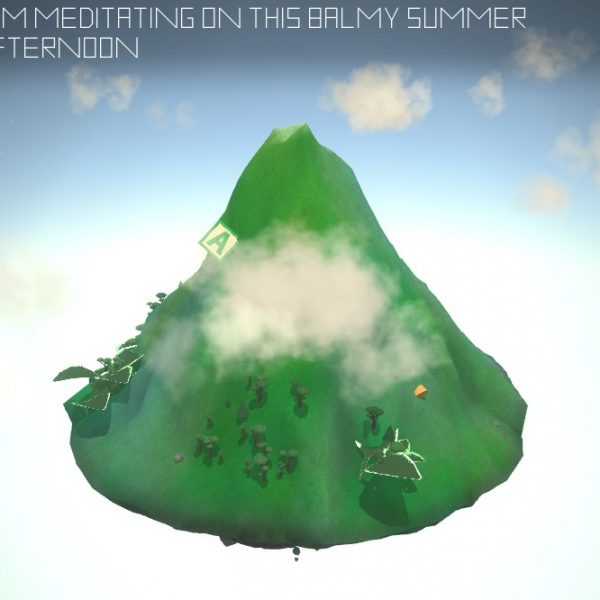
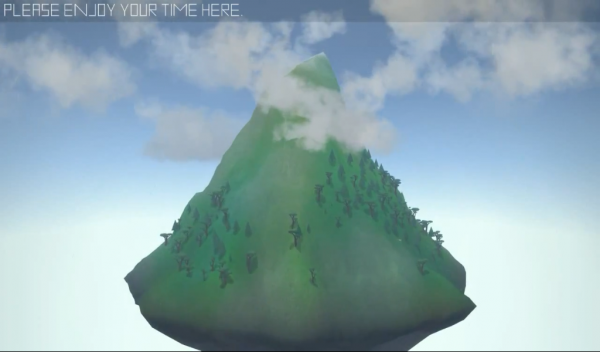
Upon entering the game you are greeted with a very lush and green hilltop. In the background you may hear blowing wind or chirping birds, while clouds drift past. You spin this hunk of land and you see nothing but a normal-looking mountain. You look underneath this massive landmark and you see gravel and foundation. This mountain is floating in space and is surrounded by an aura to keep in the atmosphere. The first impression is deliberately simple: a green hilltop, gentle sounds, drifting clouds, and a mountain that looks ordinary from above but reveals its gravel base and foundation when you turn it over. The aura around it holds that little world together as it floats in space, separate from everything else.
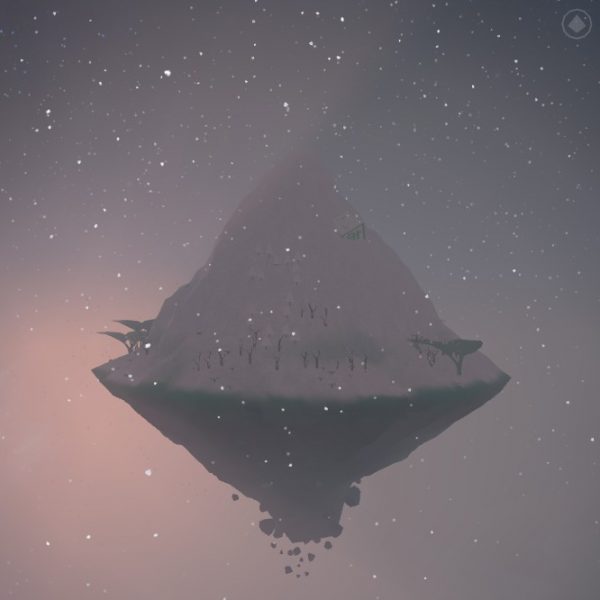
Over time, it may rain or snow, but you soon realize that is just a common thing that happens naturally. This is everything you see in the first minutes of gameplay. The weather does not arrive as a challenge or an event to react to; it simply happens, the way weather does, and then passes.
After those first minutes, the question shifts from what you are seeing to what, if anything, you are supposed to do.
Once you realize that you can’t do anything but look at this monument, you leave it on in the background thinking you might have just bought a screensaver.
Suddenly, a thought pops up in the upper left-hand corner. Some omnipresent being is having a thought while observing.
As time passes and music cues in, you start to realize things that were not there before. Your mountain starts growing new things and evolving into its own identity. The moment changes the whole feeling of the game: what seemed like a still image in the background begins to speak, in its own quiet way, and the mountain that was only there to be looked at starts to develop a life and identity of its own.
What first looked like a screensaver soon reveals itself as something that keeps growing.
This is one of the game’s unique features. Once you start the game, you cannot start it over. Each mountain is unique to the gamer. As it slowly spins, more things show up on it. The longer you have the program running the older the mountain becomes. Because you cannot start over, the mountain you get is the one you keep, and its slow spin gradually reveals new details as time passes and it grows older with the program.
My own mountain shows just how personal that growth can become.
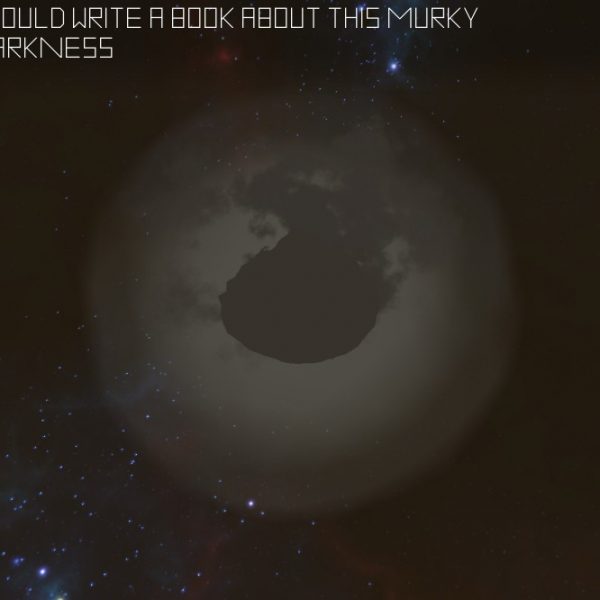
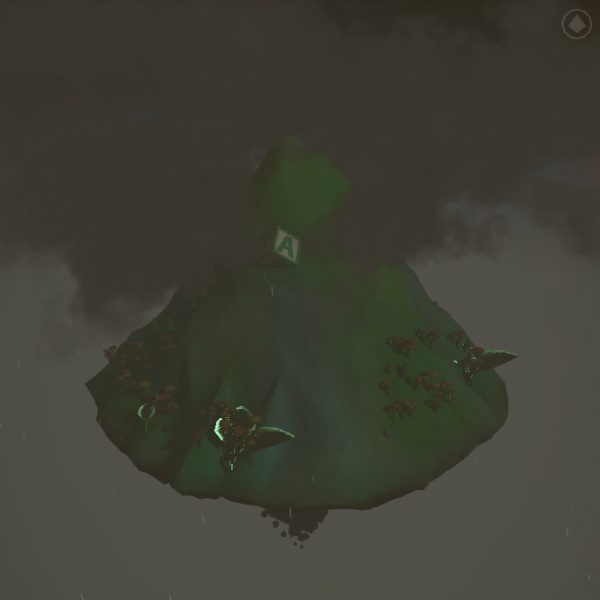
My mountain is in its infancy, so there is a giant toy block to represent its age. At night, little pixies dance in the trees. It has an adorable look to it. If the day is clear, then the omnipresent voice might type how it wishes to share this with somebody. When the day is rainy and dreary, the voice might express matching emotions, which gives you mixed feelings of who this lonely person is. The contrast is striking: on a clear day the voice sounds open and eager for company, while on a rainy, dreary day its mood turns to match the weather, leaving you wondering about this lonely voice and what it is feeling.
And that daily rhythm is what keeps the mountain’s story moving forward.
After every new dawn, you are greeted with a chime and the game saves for you, making sure you did not lose any progress as you leave the game open. Thus, the cycle continues.
That repeating cycle is also what sets Mountain apart from other simulation games.
What makes this game different from other simulation-type games? I think it has something to do with an underlying story and you are the audience watching it unfold. Instead of naturally progressing the game yourself, you are reading this story as it is happening, almost like raising a child. You are not pushing the story forward or choosing what happens next; you are watching it unfold in front of you, day by day, in much the same way you might watch a child grow and change without being able to control every step.
That feeling of watching rather than steering is exactly where the horror reading begins.
I think that is where the horror comes in. For new parents, it is a crazy ride and you don’t know what to expect, with danger and fear around every corner and not knowing what will happen next. You may have limited control, but you just have to take it day by day. The messages you get are an inner monologue and interpretation of what a child may be thinking as it sees the world through its eyes. The mountain grows as it ages, like a child would, and if you stop watching for a moment something amazing might happen. Art is supposed to be interpreted in several hundred ways and this is what I see. The horror, in this reading, is not a monster jumping out at you; it is the uncertainty itself — the limited control, the unknown future, and the thought that something wonderful, or unsettling, could happen the moment you look away.
Seen that way, the game becomes something more than a curiosity — and that is why it is worth trying.
That combination is the reason to give it a try: the serene view that first draws you in, the mountain slowly growing into its own identity, and the strange, tender mix of raising a child and facing the unknown that runs underneath it all.