

If you’ve read any of my previous reviews for games in the genre, you’ll know that I enjoy turn-based strategy role-playing games. I’ve played and loved playing games like Final Fantasy Tactics (and Final Fantasy Tactics Advance) in the past, and more recently games like Fire Emblem Fates or Mercenaries Saga 2. So when I learned that Circle was making a spin-off of Witch & Hero in this genre, I jumped at the chance to check it out. That background matters here, because this review comes from someone who already loves this kind of tactical game and was keen to see how a much simpler series would handle it.
Ambition of the Slimes is a great melding of the two. The game is very much a strategic role-playing game that also borrows a lot from the simplistic spirit of the Witch & Hero games. It is a very simple game to play, with a lot of the depth left out of the game. You don’t buy weapons, armour, or upgrades. But that lack of depth actually allows for an entirely different level of depth. In other words, the depth is not in shopping for equipment or building up gear; it is in the choices you make on the battlefield itself, in which slimes you bring, which humans you try to claim, and when you make your move.
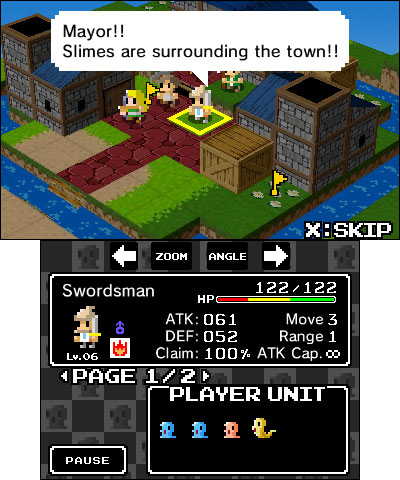
In the game you are playing as a group of slimes. That’s right, those little enemies that you’re used to fighting in role-playing games when you’re a level 1 Squire. The weak, useless slimes are all you’ve got. Except that there is a twist. While your slimes may be weak and pretty useless in battle, they have a unique ability which gives you some hope. They can hop into the mouths of the humans that are trying to wipe them out and claim them. Then you take control of the enemy and use their strengths and abilities to fight for you. That reversal is the heart of the game: the creatures that would normally be cannon fodder become your way into much stronger fighters, and every battle turns on whether you can turn an opponent to your side before it turns on you.
As you play through the levels and move on, you’ll be approached by rogue slimes that want to join your party. And there are many different kinds of slimes with many different abilities. This is where things really get interesting and where you’ll need a strong dose of strategy to keep progressing in the game. As your party grows, in other words, the question is no longer just how to win a single level, but which combination of slimes gives you the best chance in the next one.
The different kinds of slimes have their own abilities, which vary from passive abilities like boosting the attack/defense of the human you claim, to more active abilities. Some slimes can warp to any point on the map, others can teleport another slime to any point on the map, and others still can be used to support another slime in their claim attempt. You see, many of the humans have a 100% rate of success to be claimed, but others may have only a 20%, 1%, or even a 0% chance to be claimed. Some slimes have abilities to boost that chance, which can make claiming a one-two punch between the slimes. That pairing matters most when the odds are stacked against you: one slime can improve the odds, and another can then make the claim itself, turning a long shot into a workable plan rather than a gamble.
But here is where there is some strategy involved. If you move too quickly and the humans get a first attack before you can lay claim to one, then you may be out of luck. One attack can sometimes lay waste to your slime. So you may need to lure one to you so that you can claim a human before they can attack. It’s also advantageous to claim a human of the same class as your slime. Patience, then, is as important as aggression: rushing in can lose a slime before it has done its job, while drawing an enemy closer can give you the opening to claim it first.
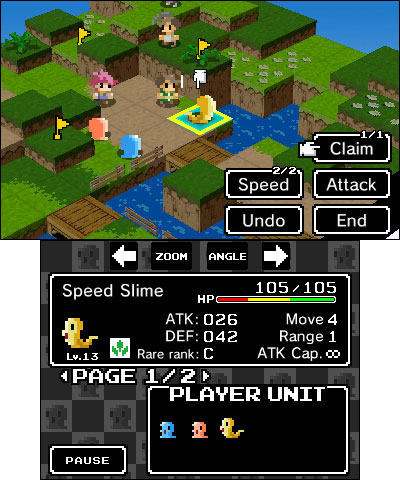
The rock-paper-scissors mechanic is used in this game, and it shapes almost every decision once you understand it.
There are three element classes to every character in the game, human and slime alike: fire, water, and grass. A character with the water element will have a stronger attack and better defense against another who is of fire, and so on. Not only is that very important to note when you’re playing a level, but if you claim a human with a slime of the same class, the claimed character gets boosted stats. In this way, it can be better to be selective about which human you claim. The choice is therefore twofold: you want an element that fares well against the enemy in front of you, and, where possible, a match between slime and human that leaves the claimed fighter stronger than it was before.
Keeping these variables in mind, it’s not uncommon to restart a level with different slimes and try another strategy. That willingness to rethink a level, rather than simply pushing forward with the same party, is part of what keeps the game engaging: a different mix of abilities and classes can change how the same battlefield plays out.
That same willingness to experiment carries over once the story levels are done, because finishing them opens up more to play.
After you beat each individual level through the story mode, you will also unlock challenge levels. These use the same terrain but add more enemies to the mix, which can give you additional chances to add more slimes to your roster. Having more slimes at your disposal, with a wide array of abilities and classes, will definitely benefit you. In short, the challenge levels are not just harder versions of familiar ground; they are another way to broaden the party that the rest of the game depends on.
That broader party helps when a level needs a fresh approach, but it does not always solve the game’s other quirk, which is how its enemies sometimes behave.
Actually, I couldn’t tell at times if the AI in the game was better than average or poor. There were a few times in the game when I felt it was a safer bet for my characters to hold back and let the enemies approach me. Whether they had a height advantage or I felt that I would have a better chance if I let them come to me, I wanted to wait them out. But more than once I would end my turn and watch as the entire batch of enemies would do the same. They wouldn’t move and wait for me to make a move. I literally did this multiple times and watched as the characters on the screen just idled, waiting for the other team to go first.
I must say that it was a great tactic on the enemy’s part, but wasn’t helpful for me. That standoff could be frustrating, even if it sometimes worked in my favour as a tactic, and it was not the only small snag I ran into.
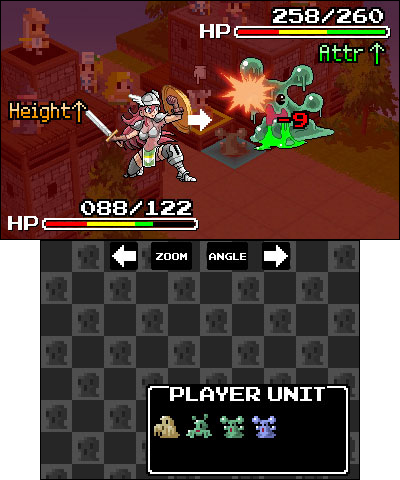
My only negative box ticked in the game is a very minor one, which doesn’t take anything away from the game itself. It’s more of a button mechanic choice in the menus prior to each battle. During battles, you press the (Y) button to pull up more details of your slimes’ abilities on the lower screen. However, when you’re selecting your slimes in the menu, you have to press the (X) button instead to do this, with pressing (Y) sending you back to the difficulty select screen. It’s a very minor thing, but it did cause me to second guess myself and press the wrong button at times. The confusion is easy to understand: the same action, checking a slime’s details, asks for a different button depending on whether you are in battle or still choosing your party.
Once you are past those menus and into a level, though, the game is easy to enjoy on presentation alone.
For such a simple-looking game, the retro-inspired visuals of Ambition of the Slimes look beautiful. The 2D sprite characters look nice in the blocky 3D landscape of the game, which in turn looks great with 3D mode turned on. And while the soundtrack was a little bit repetitive, and the English translation was a bit funky, both were done well enough that neither was that distracting. The presentation, in other words, fits the game’s straightforward approach: it is charming rather than flashy, and its small rough edges do not get in the way of playing.
Overall, Ambition of the Slimes is a great game. It’s a simple game to pick up and play and yet, at the same time, has enough depth and difficulty to keep you playing. That balance is the verdict in a nutshell: the game does away with buying weapons, armour, and upgrades, but replaces them with claiming, elements, and party choices that reward thought and patience. The occasional AI standoff and the mixed-up menu buttons are minor frustrations beside that core appeal, and they do not change the overall impression. For a player who enjoys turn-based strategy, or who simply likes the idea of winning as the slimes, this is a game well worth picking up and sticking with.