

PolyRace may seem like a deceptively basic and easy racing game at first glance, but it provides enough variety to be able to play through and try for the best times while not trying to crash and burn. After starting the game up and customizing the controls to my liking, I fired up a training mission to get a feel for the overall game. With a fresh game, the player is limited in their options for choosing hover-cars, difficulty, and track type. As one progresses through missions, those will unlock, which gives decent variety for running through races.
One of the big things that I noticed that can make things interesting is how race courses are seed generated. For people that aren’t familiar with seed generation, for this game it’s a six character set that is used as the basis for generating every race course. In this case, two letters, two digits, and two letters are used for generation, thus keeping variables limited, but not to the point of where courses are repetitive on play-through at least. With choices of desert, Arctic, and continental terrain types, courses are filled with valleys, hills, mountains, curves, straight lines, and obstacles like trees and rocks to avoid. Taking a note from the F-Zero series, the hover-car has a shield which limits how much punishment it can take at one go. Thankfully, it automatically regenerates after a time of not taking any damage, but something like a head-on collision with a mountain will make the hover-car crash and burn.
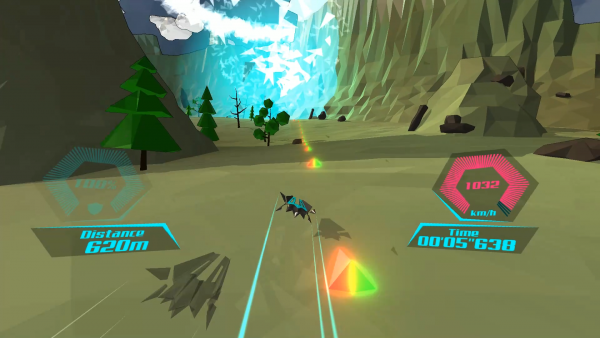
For the hovercars, there’s one that’s available to start, with three more to unlock while playing missions, along with additional color schemes for each of the hovercars. Each hovercar is unique in regards to speed, acceleration, handling, shield regeneration delay, and so on. The controls are a bit floaty, but that is to be expected when trying to control a hovercar as opposed to, say, a wheel-based vehicle. For people that aren’t used to that kind of control response, it’s really easy to crash into terrain, but it’s not difficult to get used to. The four difficulty settings scale nicely, so that while playing the easiest difficulty, it isn’t too easy, but when playing normal or hard difficulties, they aren’t harder than they should be. Graphically, PolyRace looks like it would be right at home on a Sega Dreamcast. It isn’t overtly blocky, and also isn’t entirely smooth either, which makes it easier to run on older systems such as my 7 year old gaming laptop. Missions are completed by either reaching the end of the track or by hitting checkpoints with time attack. Depending on player performance, stars may be earned to eventually unlock additional missions. In addition to that, after meeting certain requirements that are stipulated within the mission, the player can unlock the developer’s ghost for some competition. Besides being able to unlock the developer ghost, the player can compete against themselves with their own ghost after completing a course.
The music and sound within this game is what I would expect in any futuristic racing game and since the music and sound is very electronic in nature, it fits the tone of this racing game. The music tends to fit well with what the courses are at times, though at other times it is just a bit too much. The controls and the handling of the hovercars, however, take a bit of time to get used to, as well as racing against other players was not envisioned in the design. Once you’ve gotten used to the hovercars, the game has a lot to offer for a small price, though not a great deal of substance to keep you occupied. Overall, it’s a fun game to play and get through, but a difficult one to master with racing against yourself or competing with others online.
PolyRace is currently available on Steam for PC, Mac, and Linux.
Comments? Suggestions? Feel free to reach out to us on Twitter or Facebook and let us know what you think! Also check out our podcast, BrokenJoysticks: After the Fact, for more gaming news and reviews.