
Review by: Rob Logsdon
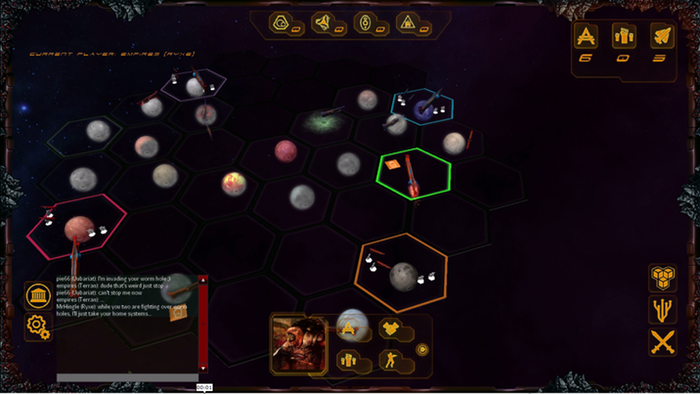
Falling Stars: War of Empire is a space sim developed by Riveted Games and published by Lock’n Load Publishing. It is a turn-based space simulation in line with Civilization. Just like in Civilization, you start with your single home planet and some ships, and you send forces out to explore. When you find a neutral planet, you have the choice to either barter with it and gain some immediate benefits, like getting some free troops or transports, or you can conquer it. Conquering a planet allows you to build an Orbital Construction facility, which allows you to build more ships and troops at that planet. So it’s a game of decisions, choosing the short- or long-term options, diplomacy, or war — and on paper, that choice between a quick payoff now and a lasting foothold for later sounds like the foundation of a proper strategy game. While this sounds like it should be the opening notes of more of a nice, in-depth symphony of a game, it is sadly not. That is the only planetary management you will get: no trading between empires and no real diplomacy at all. Folks expecting an epic 4x game in space are going to be disappointed.
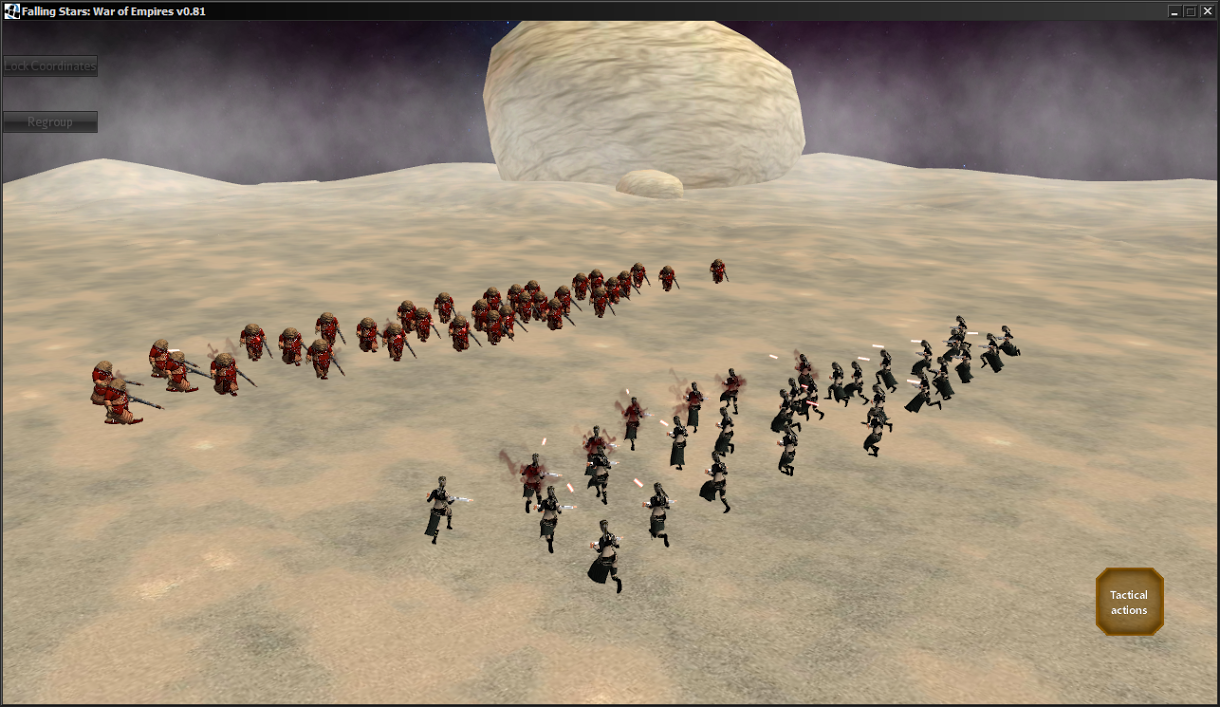
What the game actually plays like, once that first impression wears off, is something simpler. The game feels very much more like Risk than Civilization, though you may lose fewer friendships in Falling Stars than Risk. Though the game is fast-paced, I never felt like it was action-packed. There is no fog of war, so the four empires can always see one another, and you as the player must watch everything that happens each turn, even the battles between the AI. In this way, it’s similar to other turn-based games, but with no options to skip or even fast-forward these AI turns, it can really start to feel like a slog — every turn means sitting through everyone else’s moves, including fights you have no part in, before you get to play again. Like the rest of the game, the battles are very bare-bones. You can set up your ships in whatever formation you would like in the squares you are given, and then you go, and both sides continue shooting until everyone is dead. That formation step is the one moment where tactics are supposed to come in — where you place your ships, and in what shape, is meant to matter. This is supposed to let you layer in tactics to your combat, and you are supposed to be able to retreat, but it never seemed to do anything when I tried it, and I still lost all of my ships. This lack of choice really hampers the ground and space battles, which should be a true interactive experience. It makes it feel as though the battles are carried by whoever has more brute strength. There is no give and take; it pretty much just boils down to whoever brought the most ships or troops to the fight. Overall, combat feels hollow and unfulfilling, which is a disappointment, because in a 4x game, combat doesn’t have to be first and foremost, but it has to be fun and engaging.
And the hollowness does not stop at combat — it runs through the factions themselves. My next gripe with Falling Stars is that all the factions essentially play the same. Though you start with some different technologies as the different factions, by the end, everyone has fighters, troops, carriers, cruisers, and dreadnoughts — the same roster, the same tools, no matter which flag you picked at the start. Without the ability to negotiate or trade between the powers, it puts everyone into the same strategy boat. Go conquer a world and build as many things as possible to win battles and gain victory points. It makes the game feel like a race instead of a grand 4x strategy game, with every empire running the same playbook toward the same finish line. Just like most other games, you win by getting victory points. Victory points are earned several ways: first for winning battles, next for researching tier three technologies, and finally for winning the vote in the one policy that comes up at the start of each turn. Three routes to the same total, and none of them asks you to play your faction any differently from the rest.
Underneath that race sits a deliberately simple economy — just two resources, and both of them always in short supply. You have two resources in the game. First, you have resources, which are used for both building and researching technology, so a careful balance must be maintained. Second, you have fuel. This is used to move your individual ships around the map. Please take note that I said ships, not fleets: each ship uses fuel, so you have to really plan out your movements, as they can only move so far. That per-ship cost is what makes every move a small calculation — send a ship too far, and it cannot get back; hold it in reserve, and it is not where the fighting is. So a mix of luck and well-thought-out strategy is what gets your ships to the right place at the right time — hopefully. You, of course, gain more of both by either bartering with planets or taking them over. Sadly, you will never have enough of either to do everything, so planning and placement are very important to winning the game. The real downside to this simple system is that once one empire has a good number of planets under their control, they have a huge advantage, in that they can build huge numbers of ships and move them to far-flung parts of the map. Planets buy ships, ships take planets, and the loop only runs one way. This means that if you have a few small hitches early on, and overall end up with a bad start, you’re going to spend the whole game behind. Which leads me to the AI in general: there are no difficulty settings that I could find. The computer will make a near-perfect move pretty much every time; often, one or two empires quickly become dominant, and they never look back. If you are not one of them, you are pretty much toast very early in the game. This brings us to the user interface. To be honest, it is not well constructed; it was difficult to use and did not feel natural. The technology button is a building, and the menu buttons are vertical, which bothered me — an odd aesthetic choice that seems like it would work better on mobile than on desktop.
While this game certainly has the feeling of missing pieces, there are some good things to be said about it, too. One of the coolest things the developer has done is lower the price from forty dollars to twenty. This amount is a much more comfortable price for me for the included game experience — twenty dollars stings a lot less for a light, quick strategy game than forty ever did. Next is the game’s duration. While a small game of Civilization can take several hours, even if you are quick, a small game of Falling Stars can be over in as little as ten or fifteen minutes. This means you can get your fix of 4x in much, much less time than a game of Civ would take — a whole campaign in the time a single Civ session is still warming up. My first game after I completed the tutorial was over before I had a second turn. The AI had gotten ten victory points on its first turn, which was kind of disappointing. This seemed like a major flaw with the game — a match that ends before you have really played it is hard to call a match at all. That being said, the game is lacking a few things, but it does have quick gameplay for those times when you only have a small amount of time to play a game, or when you may be interrupted by life duties.
That quick-match appeal is also where the game’s promise lives. I see a lot of potential in this game, and the developers are listening to the fans and will continue to craft a better experience for us, the gamers. A game that can be played and finished in fifteen minutes, at a twenty-dollar price, with developers still shaping it, is not a lost cause — it is a rough draft with room to grow. So if you are looking for fast games that will not take you all day to finish, and one with fewer bells and whistles, then Falling Stars: War of Empire is the game for you. Just go in knowing what it is: a light, quick taste of 4x, not the epic the premise promises — and if you want your strategy deep, your battles tactical, and your factions distinct, this is not that game yet.