

Somewhere in a drawer, on floppy disks older than most of the people reading this site, sat six Sega Genesis games that never were. Now they’re playable — the best Halloween treat preservation has handed us all year.
The disks belonged to Ken Rose, a senior programmer at Sega Technical Institute hired by Mark Cerny in June 1991. Of everything he worked on over three years, only Sonic the Hedgehog Spinball ever reached shelves — he was let go on February 2, 1994, the day Sonic 3 launched. Ouch. Then, after a December 2025 interview with DevStash founder Ashley Rojas, Rose dug through his old floppies and found builds and source code spanning 1991 to 1994. Hidden Palace published the lot as its Halloween 2026 release.
The headliner is Treasure Tails, an isometric puzzle-adventure starring Sonic’s pal Miles “Tails” Prower. Sega of America asked STI for a short, simple Tails game for Christmas 1993 — then cancelled it on April 16, 1993, when sole artist Craig Stitt tallied the animation work at roughly four years. The release includes an April 1993 build, source code, and design docs revealing a tie-in to the Adventures of Sonic the Hedgehog episode “Tails’ Tale.” The team moved to Spinball the same day.
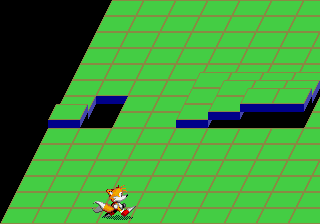
Check out gameplay from the recovered Treasure Tails build below:
Then there’s Jester — also known as Kinetix — a clay platformer with no enemies, just hazards designed to squish, burn, and maim its malleable hero for slapstick laughs. The February 1993 build shows off mechanics previously known only from magazine screenshots, like turning into a bouncing ball and riding tubes around the stage. It was reportedly nearing completion, with an April 1994 release planned, before Cerny’s departure from Sega sank it.
B-Bomb — short for “Butt-Bomb,” a Joust-style vertical platformer where you squash enemies by dropping on them — is STI’s first game written in C, and Hidden Palace calls its October 1992 build the most playable and fun of the bunch. Dark Empires, Rose’s first assignment, is a fantasy tactical strategy game whose source code survives even though it won’t compile on its own (missing art assets, sadly). A late-1991 Kid Chameleon prototype even contains leftover data matching a May 1992 Dark Empires prototype byte-for-byte. And Segapede — later renamed Astropede — is a robotic-centipede physics demo whose recovered source compiles into a January 25, 1994 build with a unique stage layout. The source bundle also hides Sonic Spinball collision code, headers from four other cancelled STI projects, the entire B-Bomb kernel, and Sega’s GEMS 2.2 audio driver. vladikcomper has prepared a restored repo so the source compiles easily today.
No AI angle here — this is 1990s code, recovered the old-fashioned way from disks that sat in a drawer for three decades.
Six games, one floppy-disk drawer, and a Tails adventure that almost was. If you’ve ever wondered what STI was building between Sonic 2 and Spinball, now you can play the answer. Which one are you trying first?
Sources: Hidden Palace, Time Extension, pantspantsrevolution, Sonic City