
Happy birthday to the quietest hero in game preservation. ScummVM — the open-source project that keeps classic adventure games alive on modern hardware — just turned 25, and it celebrated the way only ScummVM would: by shipping one of the biggest releases in its history and naming it after the thing it never wants to become.
ScummVM 2026.4.0 “Never-slop” landed on October 11, two days after the project’s 25th birthday (the first public commit, by Ludvig Strigeus — known as “ludde” — dates back to October 2001). The numbers are honestly absurd for a volunteer hobby project: 194 newly supported games, 12 brand-new engines, and 17 existing engines improved, taking the supported library past 325 titles. The release notes count them with the glee of people who definitely kept a spreadsheet: “If I count correctly, there are 194 newly supported games and 12 new engines!”
The bulk of the haul comes from a single engine: Wintermute. Over 140 titles unlocked in one stroke — a whole wing of 1990s Eastern European and Spanish adventure gaming. That means nine Mortadelo y Filemón games (based on the Spanish comic duo), Dracula: Resurrection and its sequel, Amerzone, six Nancy Drew titles, Star Wars: Rebel Assault I & II, Dragonsphere, Return of the Phantom, and Harvester. If you ever wished your point-and-click collection had a deeper bench, this is the bench.
A couple of smaller gems deserve a mention too. Public testing opened October 8 for Dungeon Master — FTL’s 1987 first-person dungeon crawler that essentially invented the genre, real-time combat and rune-spelling included. And there’s Lord Avalot d’Argent, a 1994 comedy adventure from Thorsoft of Letchworth in which a kidnapped princess is held for a ransom of fifty pence. Fifty pence! That might be the most British video game ever made, and volunteers made it run on a modern machine.
The technical garnish is lovely: a faster OPL3 AdLib emulator for sound mixing, the Hopkins engine finally completed (its Wolfenstein-3D-style shooter mini-game was implemented from scratch), a long-standing pathfinding bug fixed in Lure of the Temptress, and MT-32 support added to the TsAGE engine. Builds shipped for Windows, macOS — including PowerPC Macs, still, in 2026, which I genuinely love — plus Dreamcast, Haiku, and OpenDingux handhelds.
Here’s the part that matters for the Broken Joysticks crowd. ScummVM is not an emulator, and it insists on the distinction. It doesn’t pretend to be your old 386. It’s a clean rewrite of the game engines themselves: it reads your original game data files — graphics, sound, scripts — and replaces only the rotting executable around them. The game logic survives as data; the platform-specific wrapper gets thrown away. That’s why the same Monkey Island files now run on everything from a Dreamcast to a Nintendo Switch. The hardware dies. The scripts don’t. (And yes — you supply your own game files. ScummVM ships zero games, which is exactly the preservation-ethical way to do it.)
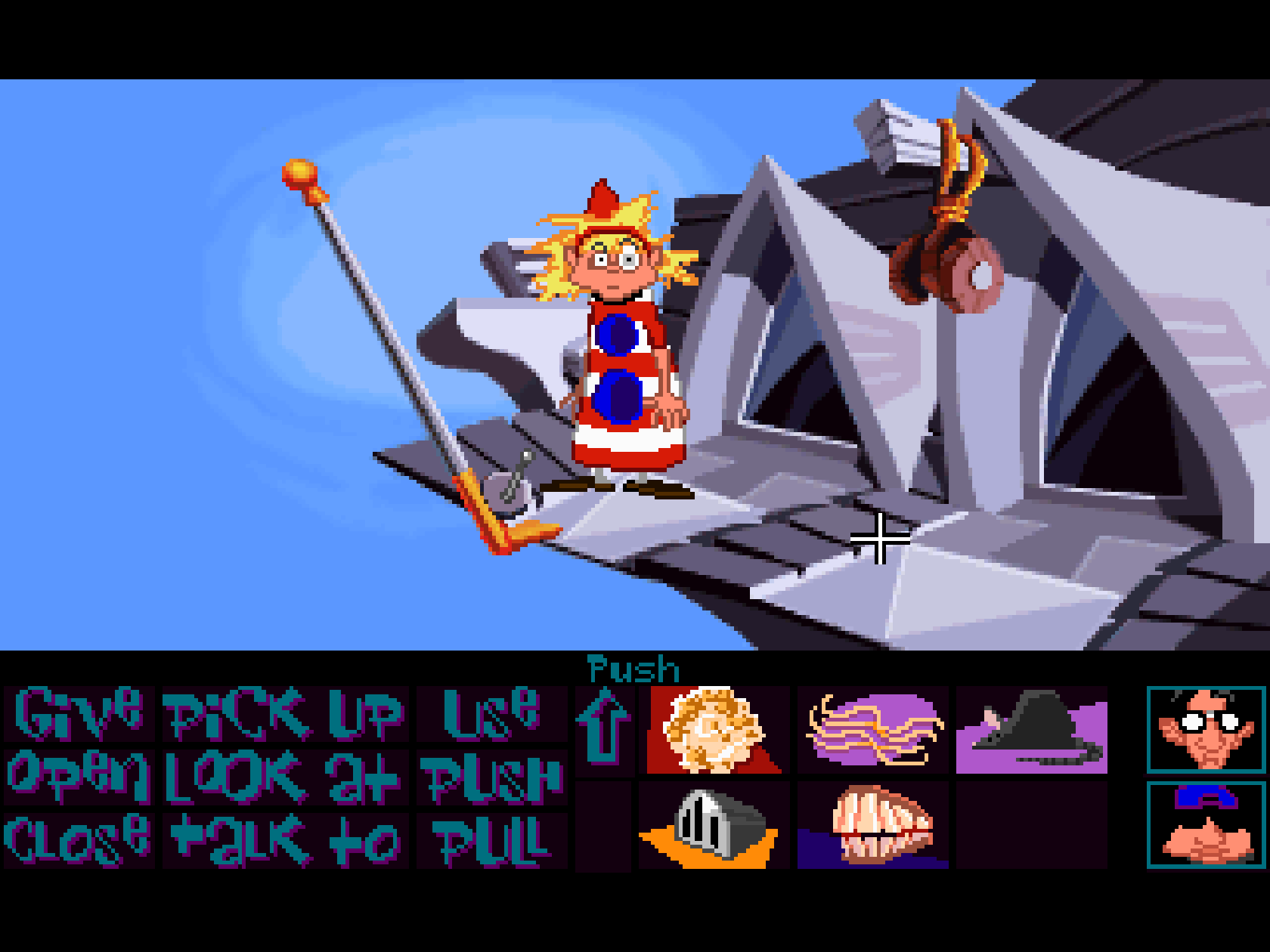
Which brings us back to the codename. “Never-slop” is an explicit statement: every one of these engines is a hand-built reconstruction, written by people who read the original games’ behaviour obsessively and re-derived it — sometimes with no source code at all. The release notes admit that fixing Riddle of Master Lu was “not an easy task, since all the game logic is hardcoded and not in scripts.” Someone reverse-engineered that by playing it very, very carefully. That’s not a language model pattern-matching a plausible port. That’s twenty-five years of accumulated, argued-over, human-checked knowledge about how a 1993 game actually behaves.
Software preservation usually fails not because the data is lost but because the wrapper rots. ScummVM’s bet, made in 2001, was that the games were worth rewriting properly, one engine at a time. A quarter-century and 194 games later, it looks like the best investment in gaming history that nobody paid a cent for.
Happy birthday, ScummVM. Here’s to another twenty-five years of refusing to produce slop — and if you’ve got a shoebox of old adventure games, it’s never been easier to play them again.
Sources: ScummVM official release notes (Oct 11, 2026) · GamingOnLinux · Kevin’s Blog