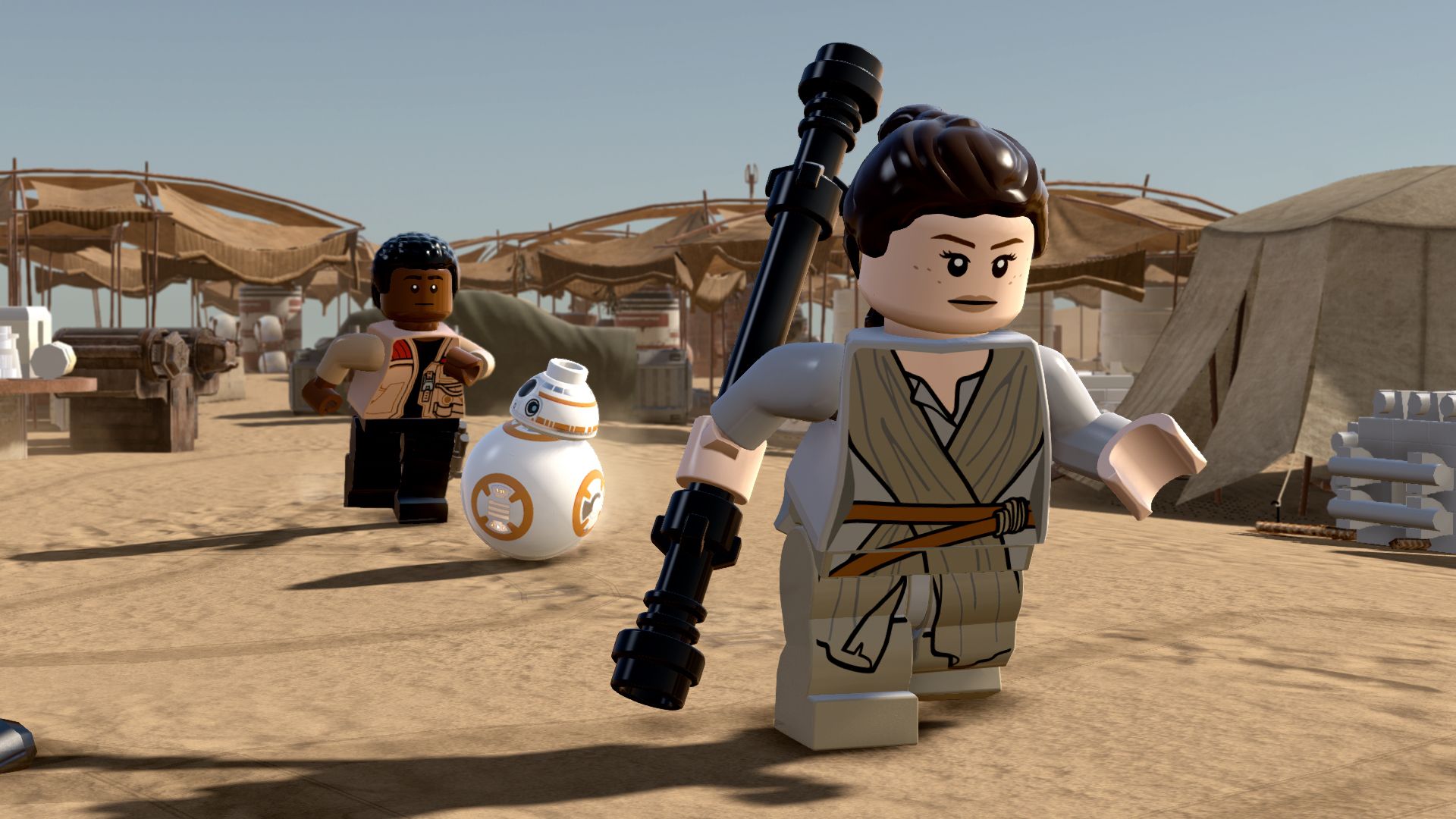
LEGO games have gone through many adventures. It’s a hit phenomenon that has even spun off a “toys-to-life” NFC game with LEGO Dimensions. The main franchise has kept a good track record of adding new content instead of just rehashing the tried and true gameplay. Sure, LEGO games feel familiar, but if you look back to the early days they really have come a long way. That familiar feel is part of the appeal, yet each entry has added something new rather than simply repeating what came before, and the distance travelled since those early days is easy to see.
In LEGO Star Wars: The Force Awakens, the franchise adds some new and interesting goodies to once again expand upon that experience. Obviously the main reason to pick up this latest release is to play through comical renditions of the movie’s memorable scenes. It may seem like there wouldn’t be much content just drawing from one film, but TT Fusion has added enough interesting content along the way to make it feel like you’re playing the adventure, rather than just watching one movie play out. That sense of playing the adventure, rather than just watching it, is exactly what the new story missions build on.
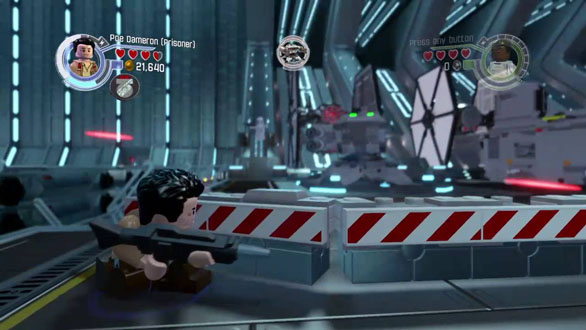
One of the biggest additions that has fans excited is missions that expand the story of The Force Awakens. The first unlockable sees Poe Dameron rescuing Admiral Ackbar from a Star Destroyer. Gold Bricks unlock this content and it makes replaying old levels worthwhile to get these new stories. It’s actually quite a nice reward instead of just getting one bonus level at the end of the game after gaining 100% in previous titles. That loop gives Gold Bricks a purpose beyond simple collection: each one can open the door to a story you have not played yet, so going back to an old level feels like progress rather than repetition, instead of a long wait for a single bonus level at 100%. Most of all, it’s the new content you’ll want to see, which gives you a real reason to chase down those levels. Those new stories are only the start, though, because the moment-to-moment gameplay has new tricks of its own.
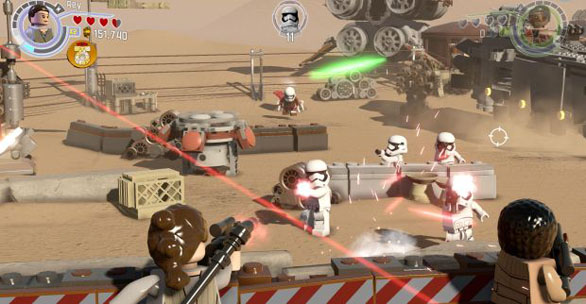
As noted above, it’s the additions that really make this yet another LEGO title that’s worth picking up. For one, there are first-person shooter scenes. That’s right! A LEGO game with FPS moments. They’re more like Gears of War really, but that shouldn’t scare any parents away from picking up the game. Naturally everything is still in a light-hearted LEGO style. It just means characters take cover behind obstacles and can pop out into first-person mode to blast away at some nearby stormtroopers. Auto-aim typically gets you right on target, but you can aim around as well to blast around the environment. Ducking behind cover, then popping out for a quick burst before ducking back again, gives those sections a steady rhythm, and while Auto-aim usually lands you on target, you are still free to aim around the environment yourself, so the shooting never feels out of step with the game’s light-hearted, parent-friendly tone. Beyond those shooter moments, the game keeps adding smaller tools that change how you look at each level.
Using scout binoculars is a fun little addition as well which allows certain characters to go into first-person to find weak points on enemies or hidden objects. The viewfinder beeps quicker and closes in on two arrow icons to indicate when you’re on the right track. It’s a basic addition, but still something that adds variety to the gameplay. Other things like computer hacking which focuses on a couple of matching games, or even language translation with C-3PO give gamers different things to focus on. Together, those three little systems give you different ways to look at the same levels: scanning for weak points and hidden objects, working through a matching game, or stopping to translate with C-3PO, each offering something different to focus on between the action. All that variety carries over when you step back from individual levels and start exploring the wider galaxy.
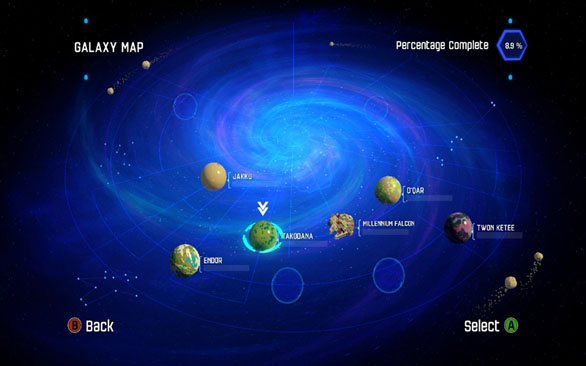
The Force Awakens, like many Star Wars movies, focused on visiting many planets. Of course this makes including a free-roam world something a bit more difficult. TT Fusion did find a way to include that experience as well though! Throughout your adventure there are free-roam areas to explore in the different sections. One even sees you completing tasks around the Millennium Falcon. Like with many games, this gives a sense of home locations that feel calmer and familiar between all the battle scenes. There are gold bricks to find in these places and new characters to recruit to use in free play, so they’re enjoyable to wander around. A single hub covering so many planets would be difficult, so instead each section gets its own free-roam pocket to explore, and the calmer home locations around the Millennium Falcon give you somewhere familiar to return to between battles, with gold bricks to find and characters to recruit for free play. Those free-roam pockets are also where playing together really comes into its own.
Like with many LEGO games, Dimensions included, I always play them multiplayer with my wife. LEGO The Force Awakens usually has that spinning split screen that decides where you are in relation to the other player and splits the screen to give you both the largest view of your area. When you get close to each other, the view merges together again. I think in free-play areas it’s split down the middle of the screen though since you can wander a lot further in those levels. It’s good to see that the co-op experience still remains strong. The spinning view is designed to give each player the largest view of their own area, and it merges again when you get close, while free-play areas split down the middle because you can wander much further apart there, a setup that keeps co-op feeling strong throughout. That same co-op spirit carries over when the action leaves the ground and takes to the skies.
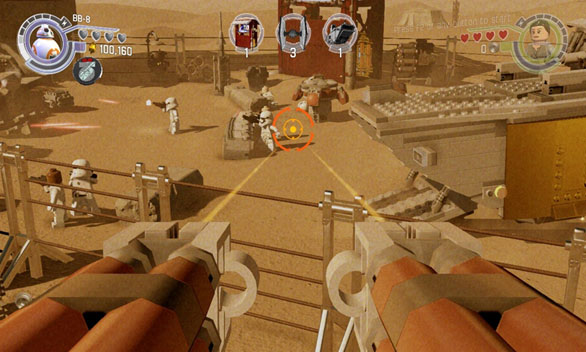
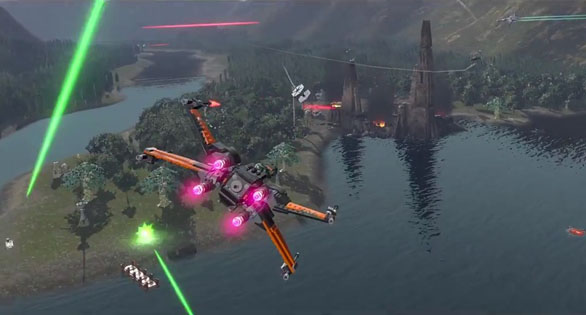
There is vehicle combat in the game as well. So you’ll occasionally take to the skies and blast away at incoming fighters. Both sections where you’re constantly flying in one direction and all-range battle arena style combat are included. These are typically quite fun and even allow the second player to take over rear-facing guns on the Millennium Falcon. The only downside I found was that it was hard to shake some enemies that had flown into formation behind you. That’s probably just me though not being sure what to do. On-rails sections keep you flying in one direction while all-range arena combat lets you move freely, and handing the Falcon’s rear-facing guns to the second player makes those flights a genuine team effort, even if enemies slipping into formation behind you prove hard to shake, which, as the writer admits, may simply have been not being sure what to do. Back on foot, the biggest set-pieces are saved for the boss battles.
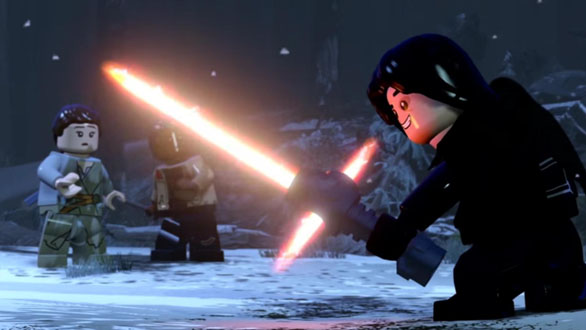
As has become the norm with LEGO games as they progress through the years, boss battles are typically puzzle based. You’ll try to find objects to destroy or build around the area to deal some damage to the enemy. This is great since it adds more to what would otherwise be a quite basic beat ’em up section. It makes boss battles an event instead of just another enemy to fight. Rather than a basic beat-’em-up, each boss becomes an event built around destroying or building objects in the arena, so the fight itself feels like a puzzle to solve. That puzzle-first approach to bosses sets the tone for the puzzles found throughout the rest of the game.
One thing I did notice was that puzzles never really became too frustrating in this outing. On the very rare occasion in previous LEGO games when you could get pretty lost on what to do or even have a glitch leave a puzzle unsolvable. I think in all our time we had one puzzle that tripped us up a bit, but probably in single player we would have received a bigger hint from the computer-controlled characters doing their part instead. As a co-op team, that focus fell on us and we had to work together to figure out what to do. So all in all not a bad thing, and certainly an improvement over those rare frustrations of the past. That single co-op stumble stands in contrast to single-player, where computer-controlled characters would likely have offered a bigger hint, and it is a welcome improvement over the rare occasions in previous games when you could get pretty lost. With puzzles rarely getting in the way, collecting studs along the way feels just as smooth.
We also found stud collection wasn’t much of an issue this time. Sure, you do still need to break everything and collect as much as you see to get your True rating in a level, but it never felt like we’d fall short of that. There was only about one level we didn’t get enough studs on before unlocking our x2 red brick multiplier. Even then, by the time we unlocked that red brick it only took running through one level to have the studs to purchase it. So for that strategy, the game is very well paced. Breaking everything in sight is still the route to the True rating, but the pacing means you are rarely left grinding: just one level fell short before the x2 multiplier was unlocked, and a single level run after that was enough to afford it. Stud collection is not the only system that rewards tinkering, though, and multi-builds take that idea even further.
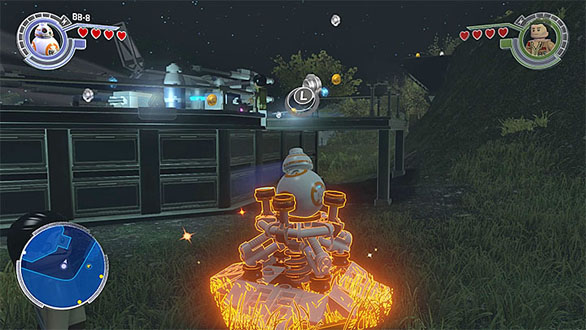
Multi-builds are the other new gameplay feature which we both loved and hated at times. Basically they are piles of bricks that can be built into more than one object. That object can then be destroyed and rebuilt into one of the other forms. I admit, there were times that characters would indicate that you needed to build a different object first instead of the one you made, but at times it felt like a chore. We weren’t too sure what would do what. Also playing co-op limited the multi-build outlines we could see at times. I don’t think we ever couldn’t see one on screen, but it did lead to us just holding in one direction to see if we could build left, right or center. In general they are fun, but any time we weren’t sure if the object we made was what we wanted first, it kind of slowed us down. Multi-builds aren’t bad, and it’s a clever idea considering it is an actual LEGO feature for the real brick sets you can buy. We just wished that you could get more hints to speed things along or even build more of a story around the puzzle. Yes, I get that it would detract from it being a puzzle, however. Perhaps even a small title under each multi-build could have helped so we could see things like, “Water tank”, “Pump”, “Power source”, and decide which was important to build first. That loved-and-hated tension comes from the same idea: a pile of bricks that can become more than one object is clever, especially as a real LEGO-set feature, but when you are not sure which object to build first, or co-op limits the outlines you can see, the fun can turn into guesswork. Even with that occasional friction, the overall experience still leaves a very clear impression.
Overall, the game is great! There’s lots going on, enjoyable moments with a wide variety of characters, and a good mix of gameplay that keeps each level entertaining. Some previous games could feel a bit exhausting in longer levels, but thanks to mixing things up with the first-person shooter-like sections and aerial combat, the levels kept us interested, and those longer levels never felt exhausting here. There’s a lot of fun to be had here and the season pass adds even more interesting levels into that mix. LEGO TFA is a worthy addition to the Traveller’s Tales games and this one celebrates the return to the Star Wars universe. The multi-build friction is a minor gripe against that positive verdict, and it does not change it: the variety, the mix of gameplay, and the extra levels from the season pass still make this a worthy addition to the Traveller’s Tales games celebrating the return to Star Wars.